
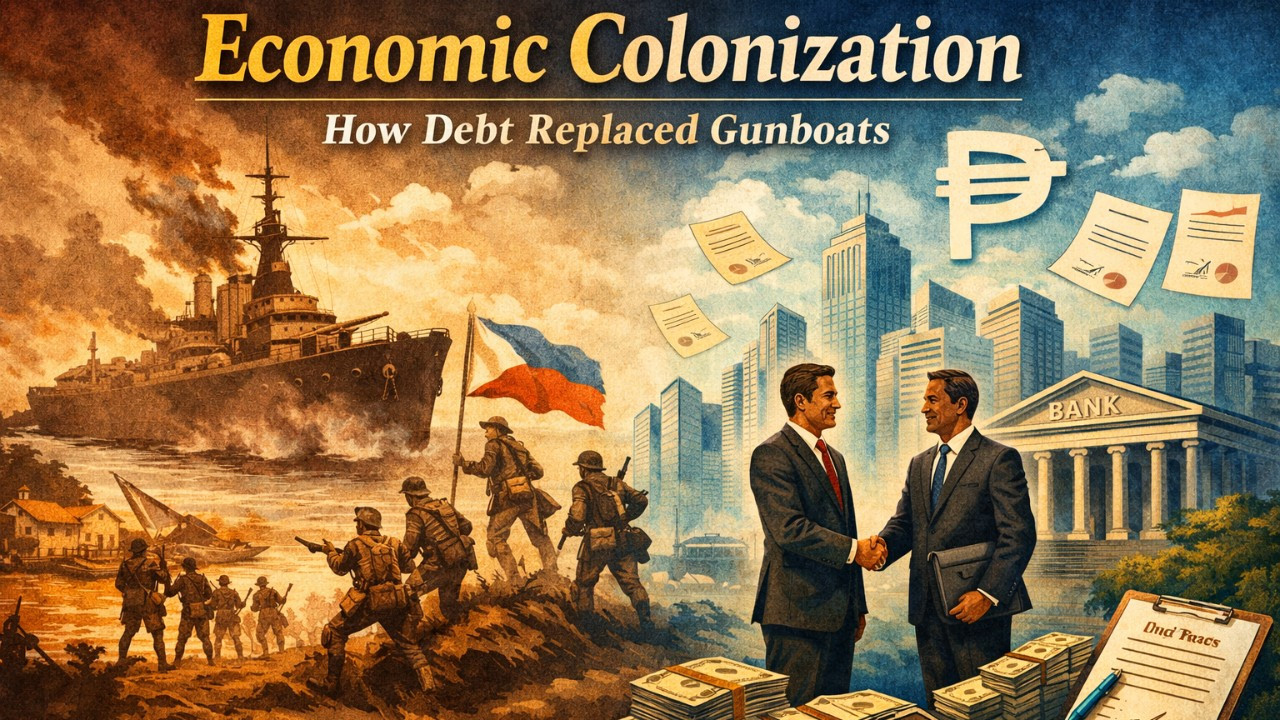
Economic Colonization: How Debt Replaced Gunboats
There was a time when foreign powers arrived in our waters with gunboats.Cannons faced our shores. Soldiers marched through our towns. Flags were planted by force.
Today, the ships still come. But they carry no cannons.
They carry loans.
The uniforms have been replaced by suits. The occupation no longer needs soldiers. It only needs signatures.
And while no foreign flag flies over Malacañang, the question remains: are we truly free when we owe P16.31 trillion?
From Military Conquest to Financial Control
In the past, colonization was obvious. Spain ruled through friars and force. The United States ruled through administrators and military bases. Control was visible.
Modern control is subtler.
Instead of gunboats, we have bond markets.
Instead of governors-general, we have credit ratings.
Instead of decrees, we have loan agreements.
Debt has become the quiet instrument of influence.
No nation invades us. We invite lenders in. We negotiate. We agree. We borrow. And with every trillion added, the space for independent decision-making narrows.
At P16.31 trillion, our national debt is no small figure. It is not abstract. It is not just a number on a government website. It represents future taxes, future austerity, future compromises.
It represents obligations that will shape policies for decades.
Who Truly Benefits?
Debt in itself is not evil. A nation can borrow to build infrastructure, develop industries, and uplift its people. But debt becomes dangerous when:
- Borrowing outpaces productive growth
- Interest payments consume essential budgets
- Policies are shaped to maintain lender confidence rather than serve citizens
When a large portion of national revenue goes to servicing debt, what happens?
- Schools wait.
- Hospitals struggle.
- Farmers remain unsupported.
- Industries remain underdeveloped.
We are told borrowing is necessary for development. Yet if development does not free us from borrowing, then what kind of development is it?
If we must keep borrowing to sustain what we built with borrowed money, then we are not building sovereignty. We are building dependency.
Credit Ratings Over Citizens
Modern governments fear one thing almost as much as invasion: a downgrade.
A credit rating cut can weaken currency, increase borrowing costs, and shake investor confidence. So policies are crafted not just for the Filipino people, but for global financial markets.
When decisions are made, do we ask:
Is this good for Filipino workers?
Or
Will this satisfy international creditors?
This is the silent shift. The battlefield is no longer territory. It is fiscal policy.
The Psychological Colonization
The most dangerous colonization is not territorial. It is mental.
- We begin to believe we cannot function without foreign loans.
- We assume we cannot industrialize without external approval.
- We accept that development must be financed from abroad rather than built from within.
A sovereign nation should aim for productive strength. Strong agriculture. Competitive manufacturing. Energy independence. Local industries that generate real wealth.
Debt should be a tool, not a crutch.
At P16.31 trillion, we must ask: are we using debt, or is debt using us?
The Illusion of Growth
GDP may rise. Infrastructure may expand. But if the foundation of that growth is sustained borrowing, the independence is fragile.
Real economic freedom means:
- Producing more than we import
- Building industries that export value, not just labor
- Strengthening food and energy security
- Reducing vulnerability to external shocks
Without these, growth becomes cosmetic. The structure looks modern, but the foundation is externally financed.
And externally influenced.
Freedom Without Gunfire
No one has invaded us.
No one has declared us a colony.
But if fiscal pressure can shape policy, if debt obligations dictate national priorities, if economic vulnerability limits our diplomatic choices, then colonization has simply evolved.
The gunboats are gone.
The contracts remain.
The Choice Before Us
Nationalism is not about rejecting the world. It is about strengthening ourselves within it.
- Borrow when necessary. But build so we do not always need to borrow.
- Invest in industries that multiply wealth, not just infrastructure that impresses.
- Empower Filipino enterprises. Protect local production. Develop technology. Strengthen rural economies. Reduce trade deficits. Demand transparency in how debt is used.
P16.31 trillion is not just a statistic. It is a warning.
If we are not careful, future generations will inherit not just obligations, but limitations.
True independence is not declared. It is sustained.
And the question every Filipino must ask is this:
Are we financing our future?
Or mortgaging it?