
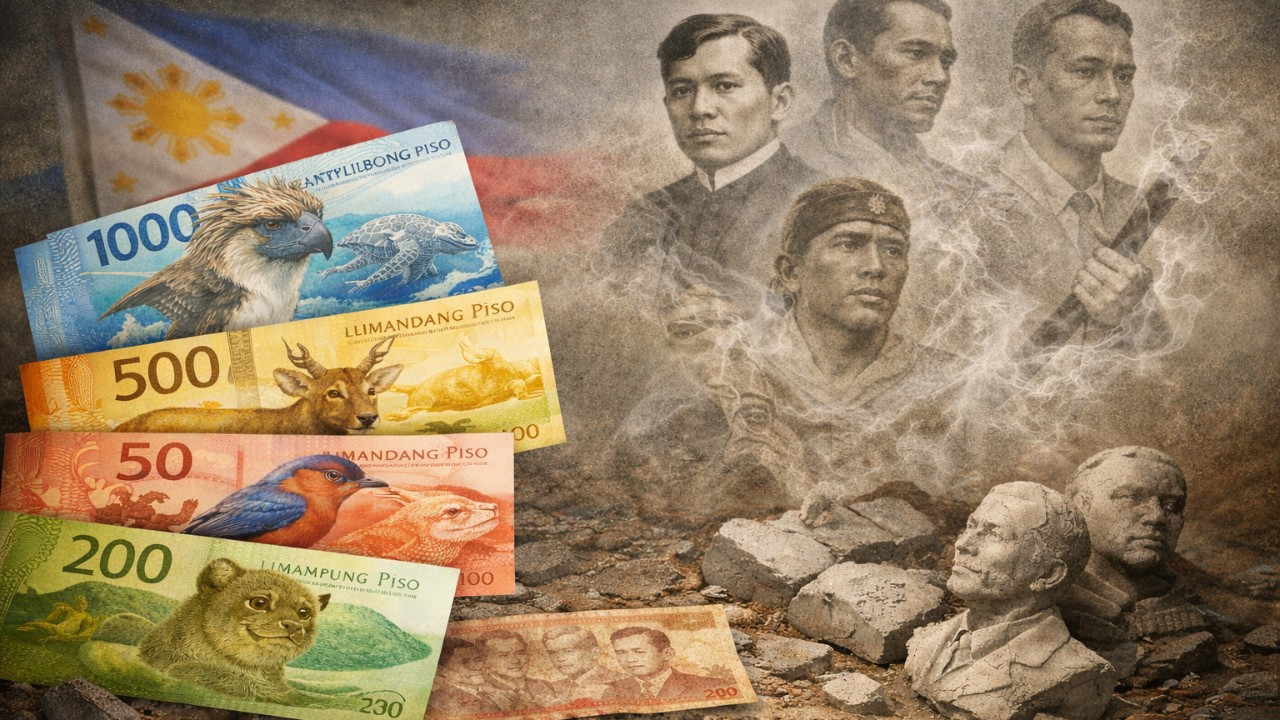
When Heroes Disappear from Our Money
Currency is more than a medium of exchange. It is a daily reminder of who we are as a nation and what we choose to honor. For generations, Philippine banknotes carried the faces of national heroes who fought, sacrificed, and sometimes died for freedom. These images served as quiet lessons in history, passed from hand to hand, wallet to wallet. Today, that connection is fading.
With the introduction of the new Philippine polymer banknotes, the faces of national heroes have been replaced by images of animals and natural scenery. While these designs are often defended as modern, clean, and globally appealing, their symbolism raises serious questions. The removal of heroes from everyday currency marks a shift in how the nation presents its identity, memory, and values.
Supporters of the new designs argue that showcasing biodiversity promotes environmental awareness and avoids political controversy. Animals, they say, are neutral and unifying. Yet neutrality is precisely the concern. Heroes are not neutral. They represent struggle, resistance, and sacrifice. By replacing them with animals that carry no historical voice, the currency becomes disconnected from the nation’s story.
For ordinary Filipinos, money is one of the most constant objects in daily life. It is seen more often than textbooks or monuments. When heroes disappear from banknotes, especially for younger generations, history becomes less visible and less personal. Names like Bonifacio, Mabini, Quezon, and others no longer appear in routine transactions. Over time, this absence risks turning history into something distant, abstract, and easy to ignore.
This change also reflects a broader trend. The Philippines increasingly adopts global aesthetics that favor simplicity and marketability over historical depth. While modernization is not inherently wrong, it becomes problematic when it strips away meaning. A nation that removes its heroes from its currency may be signaling discomfort with its own past, especially the parts that involve resistance, revolution, and defiance of foreign rule.
The choice to replace heroes rather than coexist with them is especially telling. Many countries successfully combine natural symbols with historical figures, reinforcing both environmental pride and national memory. The Philippine decision to remove heroes entirely suggests not just a design preference, but a shift in priorities. It favors safety over substance and neutrality over identity.
There is also a deeper cultural implication. Heroes remind citizens that freedom was earned, not given. They challenge people to reflect on courage, sacrifice, and responsibility. Animals, while beautiful and important, do not carry the same moral weight. They do not ask difficult questions about power, oppression, or independence. When symbols of struggle are removed, the public narrative becomes softer and less confrontational.
This is not an argument against environmental awareness or modern materials. It is an argument for balance and memory. A nation can celebrate its biodiversity without erasing its heroes. It can modernize without disconnecting from its roots. Progress should add layers to identity, not strip them away.
The disappearance of heroes from Philippine currency may seem like a small change, but symbols matter. They shape how people remember, what they value, and how they understand their place in history. When a nation no longer places its heroes in the hands of its people, it risks raising generations who know the price of everything, but forget the cost of freedom.