
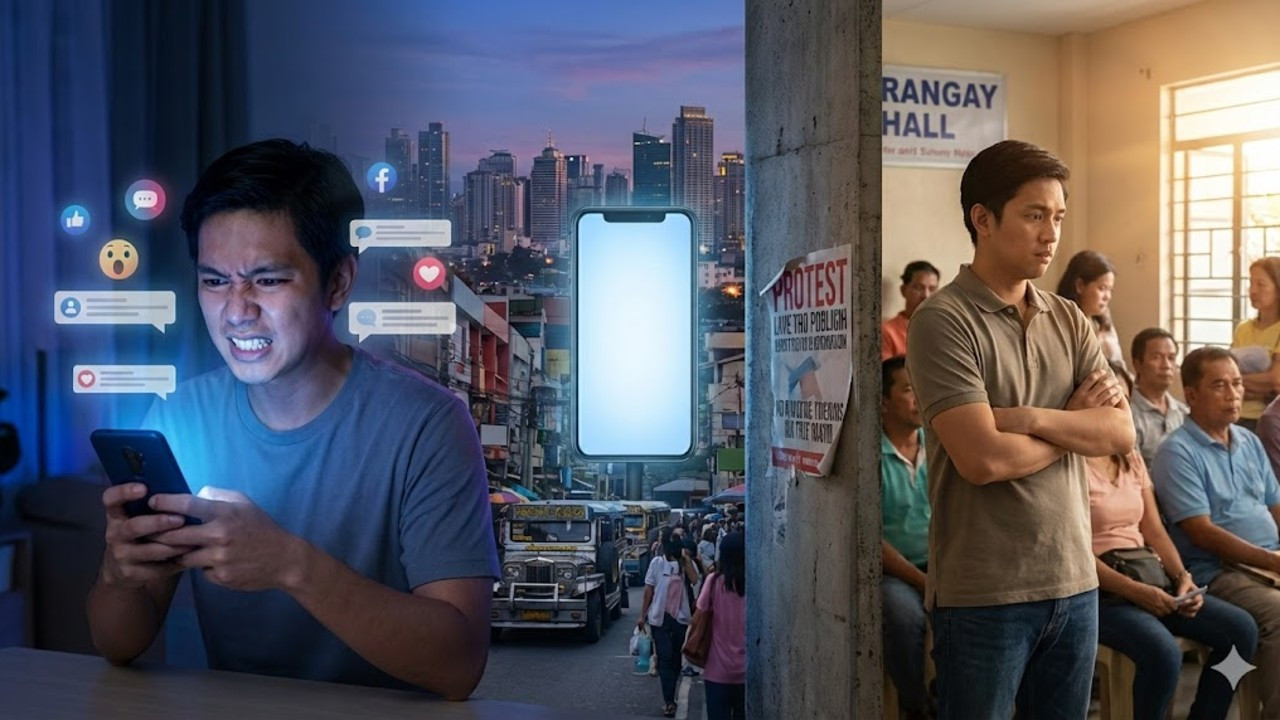
Why Filipinos Complain Online But Stay Silent Offline
Filipinos are not silent.
He tweets.
She posts.
They comment.
We react.
We are among the most active social media users in the world. Filipinos consistently rank at the top in hours spent daily on platforms like Facebook, TikTok, and YouTube. Political issues trend within minutes. Scandals explode overnight. Hashtags rise like storms.
And yet, in the streets, in barangay halls, in public consultations, in school board meetings, in policy hearings, the noise fades.
Why do we roar online but whisper offline?
This is not an insult.
It is a mirror.
Social Media Feels Powerful
Online, every Filipino has a microphone.
You can criticize a senator in the morning and argue with a stranger by lunch. You can post evidence, screenshots, opinions, and memes instantly. You receive likes. Shares. Validation.
It feels like participation.
And in some ways, it is.
But digital expression is not the same as civic engagement.
Typing is easier than organizing.
Sharing is easier than showing up.
Reacting is easier than reforming.
The algorithm rewards outrage, not discipline.
The Culture of Hiya and Pakikisama
Offline, Filipino culture becomes more complex.
We are raised with hiya, a deep sensitivity to embarrassment or shame.
We value pakikisama, maintaining smooth relationships and avoiding confrontation.
To question a superior publicly feels disrespectful.
To challenge a community leader feels uncomfortable.
To criticize openly can feel socially risky.
So we vent online, where distance protects us.
Offline, we hesitate.
We do not want to be labeled troublemaker.
We do not want conflict.
We do not want isolation.
But democracy requires discomfort.
Fear Is Not Gone
We cannot ignore history.
Centuries of colonization taught survival through caution.
Authoritarian periods taught that speaking too loudly could have consequences.
Even today, whistleblowers and activists sometimes face harassment, red-tagging, or legal pressure.
Whether the threat is large or small, the psychological memory remains.
So many Filipinos calculate silently:
Is this worth the risk?
Will this change anything?
Will I just suffer alone?
When institutions feel distant, silence feels safer.
Economic Survival Comes First
Let us be honest.
Most Filipinos are tired.
Long commutes.
Low wages.
Rising prices.
Family obligations.
When you work 8 to 10 hours a day and commute 2 to 4 more, where do you find the energy for town halls and policy forums?
When you live paycheck to paycheck, protesting feels like a luxury.
Economic vulnerability weakens civic participation.
A nation struggling to survive has little time to fight structurally.
Outrage Without Structure
Online anger is fast.
Real change is slow.
Posting requires seconds.
Policy reform requires years.
We are trained by digital platforms to expect instant reaction. But nation-building requires sustained pressure, organized movements, research, negotiation, and institutional engagement.
Memes create awareness.
They rarely create laws.
And when online outrage fades after 48 hours, leaders learn a lesson:
Wait it out.
Political Dynasties Understand This
In many provinces, the same surnames dominate elections for decades. Despite online criticism, they win.
Why?
Because offline machinery matters more than online noise.
Ground campaigns.
Local alliances.
Vote buying.
Community networks.
Barangay influence.
A trending hashtag does not defeat a well-organized political machine.
And until online frustration translates into organized civic action, the status quo remains comfortable.
The Illusion of Participation
Social media gives us something dangerous:
The feeling that we already did our part.
We commented.
We shared.
We exposed.
We debated.
Dopamine is released.
Validation is received.
And psychologically, it feels like action.
But the pothole is still there.
The corrupt system is still intact.
The underfunded hospital is still overcrowded.
Real participation requires stepping beyond the screen.
But We Are Not Cowards
Let us not mistake this pattern for weakness.
Filipinos have proven courage repeatedly.
The 1896 Revolution.
People Power in 1986.
Local community actions during disasters where ordinary citizens moved faster than institutions.
We are capable of collective action.
But collective action requires belief.
Belief that showing up matters.
Belief that voices together are stronger than voices alone.
Belief that change is possible beyond elections.
From Keyboard to Community
The question is not whether Filipinos care.
We care deeply.
The question is whether we are willing to convert digital frustration into civic discipline.
Attend barangay assemblies.
Study local budgets.
Support reform-oriented candidates beyond popularity.
Organize cooperatives.
Build local industries.
Strengthen civic education.
Demand transparency consistently, not seasonally.
Nationalism is not loud anger.
It is long-term commitment.
Silence Is Also a Choice
When we complain online but remain silent offline, we unintentionally train our leaders to ignore us.
Noise without structure becomes background sound.
The Filipino voice is powerful.
But it must move from reaction to organization.
From trending to transforming.
From venting to building.
We do not lack intelligence.
We do not lack passion.
We do not lack courage.
What we lack is sustained, disciplined civic action.
If we want a stronger Philippines, the next step is simple but uncomfortable:
Log out sometimes.
And show up.