
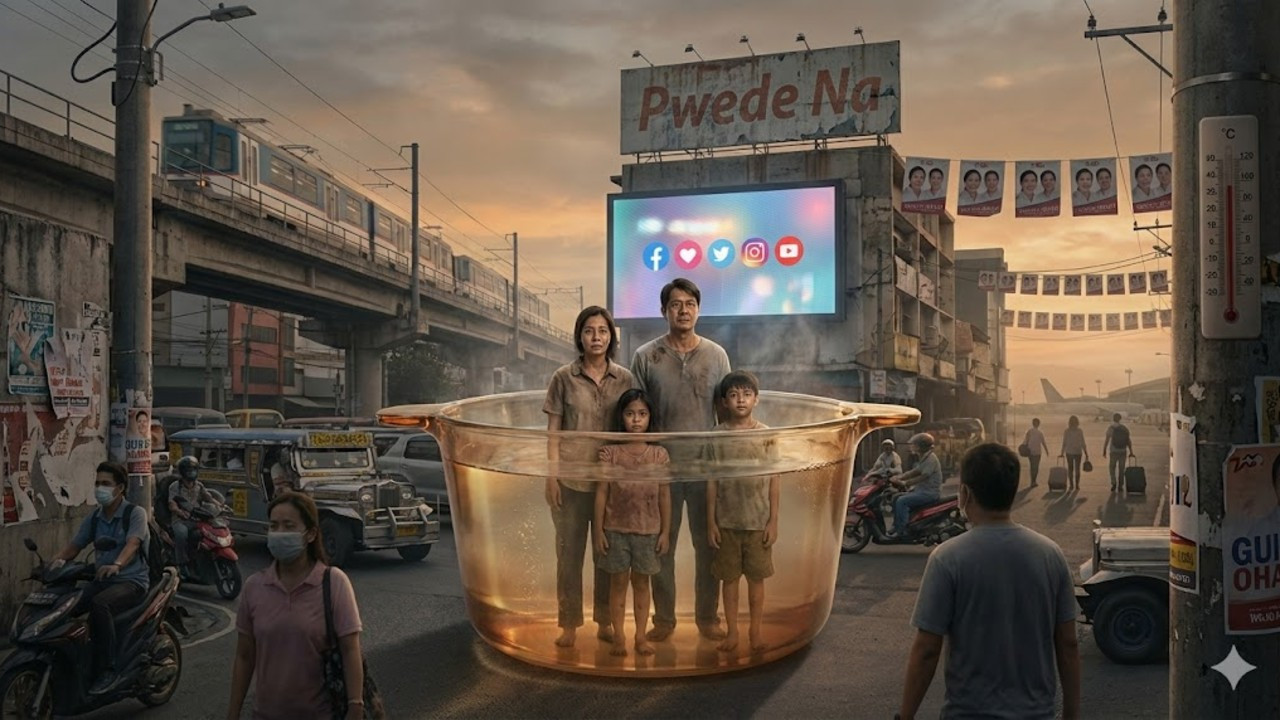
The Boiled Frog Nation: How Filipinos Slowly Accepted Less
There is a story about a frog placed in boiling water.
It jumps out immediately.
But place that same frog in cool water and slowly raise the temperature, and it stays. It adapts. It tolerates. Until it is too late.
Whether the story is scientifically accurate or not is irrelevant.
Because as a metaphor, it feels uncomfortably familiar.
Are we becoming a boiled frog nation?
The Slow Normalization of Hardship
Hardship is not new to Filipinos. Typhoons, earthquakes, colonialism, war, dictatorship, corruption. We endure.
But endurance is different from acceptance.
When rice prices rise beyond what ordinary workers can comfortably afford, we adjust.
When transportation becomes more expensive, we adjust.
When wages fail to keep up with inflation, we adjust.
When public services underperform, we adjust.
In recent years, inflation climbed above 6 percent at its peak. Food inflation hit even higher levels. Yet instead of collective outrage demanding structural reform, most families simply tightened budgets.
We normalize survival mode.
And survival mode becomes the standard.
Wages That Do Not Match Reality
The Philippines has one of the lowest minimum wages among emerging Asian economies when adjusted for cost of living in major cities.
In Metro Manila, daily minimum wage hovers around levels that barely cover basic necessities for a family when housing, food, transportation, utilities, and education are considered together.
Yet many Filipinos have accepted that:
-
Working two jobs is normal.
-
Commuting four hours daily is normal.
-
Living abroad is the ultimate goal.
-
Having no savings is normal.
When struggle becomes culture, aspiration shrinks.
Corruption Fatigue
Transparency International has repeatedly ranked the Philippines in the lower half of global corruption perception indexes.
Scandals erupt.
Investigations begin.
Public anger trends on social media.
Then silence.
The next controversy replaces the last one.
We have seen pork barrel scams, procurement anomalies, questionable infrastructure contracts, and political dynasties dominating provinces for decades.
Yet political families continue to win elections.
Why?
Because repetition numbs.
Outrage without consequence becomes entertainment.
And entertainment does not produce reform.
Political Dynasties and Shrinking Expectations
More than 70 percent of members of Congress reportedly come from political families. In many provinces, the same surnames rotate positions across generations.
We have normalized it.
Instead of asking why leadership is recycled within families, we ask which dynasty is “less bad.”
Instead of demanding structural reform, we choose between familiar names.
When citizens stop expecting transformation and settle for damage control, the water gets warmer.
Infrastructure Without Industrial Strength
We see new roads, bridges, rail lines.
These are necessary. Infrastructure matters.
But infrastructure without strong domestic industry means we still import steel, machinery, technology, and expertise.
We celebrate construction projects, yet remain dependent on foreign loans and foreign contractors for major components.
Progress becomes visual, not structural.
We accept symbols of development while ignoring foundations.
The Culture of “Pwede Na”
Perhaps the most dangerous psychological shift is summarized in two words:
Pwede na.
It will do.
It is good enough.
At least meron.
This mindset appears in public service, in product quality, in governance, in daily transactions.
Broken sidewalks.
Slow bureaucracy.
Overcrowded public hospitals.
Aging classrooms.
Internet speeds that lag behind neighbors in the region.
Instead of demanding world-class standards, we compare ourselves to worse situations and feel relief.
Relief is not progress.
Social Media as Pressure Release
Filipinos are among the most active social media users in the world.
Complaints trend daily.
Memes mock corruption.
Satire replaces protest.
But digital outrage often functions as a pressure valve.
We vent.
We laugh.
We move on.
Real structural change requires sustained civic engagement, policy literacy, economic strategy, and long-term discipline.
Memes cannot replace movements.
Brain Drain as Silent Vote of No Confidence
Every year, thousands of skilled professionals leave.
Nurses.
Engineers.
IT specialists.
Seafarers.
Teachers.
Remittances contribute billions of dollars annually, stabilizing the economy.
But what is migration if not a silent referendum?
When the best option for personal advancement is departure, it signals something deeper.
Instead of asking why talent leaves, we celebrate their resilience abroad.
Again, we adapt.
Psychological Conditioning Over Generations
Centuries of colonization conditioned Filipinos to adjust to authority rather than reshape it.
Spanish rule lasted over 300 years.
American rule reshaped institutions and education.
Japanese occupation brought wartime trauma.
Martial law reshaped political fear.
Each period demanded adaptation for survival.
Adaptation became instinct.
But in peacetime, constant adaptation without assertive reform becomes stagnation.
We are strong people.
But strength without direction becomes tolerance of decline.
Are We Truly Powerless?
No.
History proves otherwise.
The 1896 Revolution.
The People Power movement of 1986.
Local reform movements across municipalities.
Community-driven disaster responses stronger than state systems.
Filipinos can mobilize.
But mobilization requires belief that something better is possible.
If expectations remain low, demands remain low.
And when demands remain low, leadership performs at that level.
Turning Down the Heat
The boiled frog metaphor is not destiny.
The water can cool.
But first, we must recognize the temperature.
We must ask:
Why are wages not aligned with productivity?
Why are political dynasties still dominant despite constitutional prohibitions against them?
Why is industrialization slow?
Why do we tolerate mediocre public service?
Why is leaving seen as success?
National renewal begins with raising standards.
Not violently.
Not recklessly.
But deliberately.
Demand better governance.
Demand stronger industry.
Demand educational reform.
Demand accountability.
Demand excellence.
The Filipino is not weak.
But a nation that slowly accepts less will eventually receive less.
The question is not whether we can endure.
We always have.
The question is whether we will continue adapting to decline,
or finally decide that the water is too hot.