
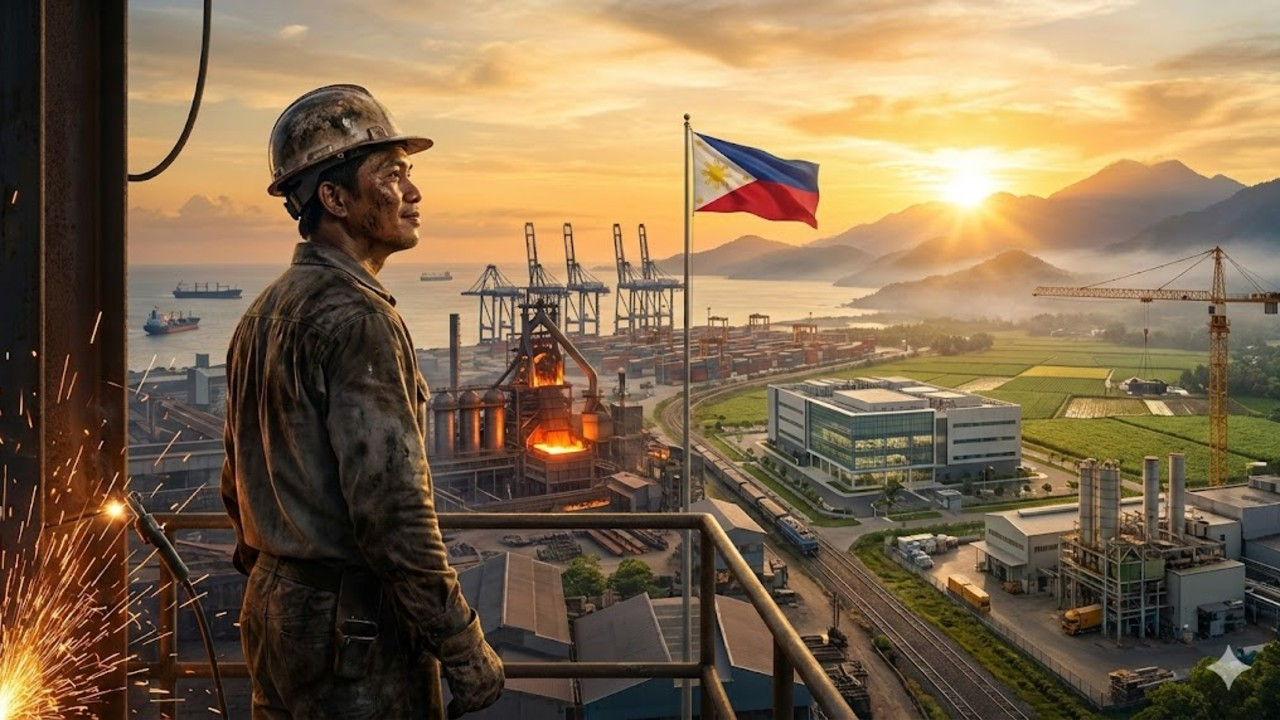
Why the Philippines Must Build Its Own Industries Again
Why the Philippines Must Build Its Own Industries Again
There was a time when the Philippines produced what it needed.
Before the era of extreme import dependence, we had steel, shipbuilding, textile manufacturing, sugar milling, coconut processing, footwear industries in Marikina, and a growing electronics base. We were not perfect. But we were building.
Today, we assemble. We import. We consume.
And we call it development.
If we are serious about sovereignty, stability, and dignity as a nation, the Philippines must rebuild its own industries again.
Not for nostalgia.
For survival.
A Nation That Imports What It Used to Produce
The Philippines is one of the most import-dependent countries in Southeast Asia.
In 2023, Philippine imports reached over 125 billion US dollars, consistently exceeding exports. This creates chronic trade deficits. A trade deficit means we buy more from the world than we sell to it. That gap must be financed through debt, foreign investment, or remittances.
We import rice despite being an agricultural country.
We import steel despite having mineral resources.
We import refined petroleum because we closed our refineries.
We import machinery, vehicles, fertilizers, and even basic manufactured goods.
The result is structural vulnerability.
When global supply chains break, prices rise here.
When oil prices spike, inflation hits Filipino families first.
When the peso weakens, imports become more expensive, and everything follows.
In 2022 and 2023, inflation surged past 6 percent, driven largely by food and fuel imports. A nation that does not produce its essentials will always be at the mercy of those who do.
That is not independence.
The Collapse of Filipino Industrial Ambition
We once had a stronger industrial direction.
The Bataan Nuclear Power Plant was built in the 1980s but never operated.
The National Steel Corporation was privatized and eventually collapsed.
The textile industry that once employed hundreds of thousands declined due to cheap imports.
Our shipyards, once among the largest in the world in Subic, struggled under foreign control and financial pressure.
Instead of strengthening domestic capacity, we embraced an economic model centered on:
-
Labor export
-
Import liberalization
-
Consumption driven by remittances
-
Foreign-owned export processing zones
Today, over 10 million Filipinos work abroad. Remittances account for roughly 8 to 9 percent of GDP annually. These remittances stabilize our economy.
But remittances are not industrialization.
They are survival income.
We cannot forever export our people while importing our future.
Electronics Without Ownership
Supporters of the current system often say: the Philippines is a major exporter of electronics.
Yes, electronics account for more than half of Philippine exports.
But look deeper.
Much of our electronics sector involves assembly and testing for multinational corporations. The high-value components, patents, semiconductor design, and advanced manufacturing remain abroad. We provide labor and location. They keep technology and control.
That means limited technology transfer.
Limited domestic innovation.
Limited strategic independence.
We participate in global value chains without controlling them.
Debt and Dependency
As of 2024, Philippine national government debt stands at over 14 trillion pesos.
Debt itself is not evil. But debt without productive industrial capacity becomes dangerous.
If we borrow to consume imports, we weaken.
If we borrow to build factories, power plants, railways, and research institutions, we strengthen.
Industrialization is the difference between productive debt and dependent debt.
Countries that became strong did not rely purely on free trade theory. South Korea, Taiwan, Japan, and even the United States protected infant industries, invested in state-led industrial policy, and supported strategic sectors before opening fully to global competition.
They built first.
They liberalized later.
We liberalized first.
And we are still waiting to build.
Agriculture Without Processing Is Poverty
We export raw bananas, pineapples, coconut products, and minerals.
But who captures the highest value?
Not the farmer.
Not the small miner.
Not the Filipino worker.
When we export raw materials and import finished goods, we stay at the bottom of the value chain.
Industrialization means:
-
Steel plants to process our minerals
-
Fertilizer plants to support farmers
-
Food processing industries to add value
-
Machinery manufacturing to support agriculture
-
Energy security to power it all
Without industry, agriculture remains fragile.
Without industry, wages remain low.
Without industry, the middle class shrinks.
National Security Is Industrial Capacity
Modern sovereignty is not only about flags and speeches.
It is about supply chains.
Can we produce our own fuel?
Can we produce basic defense equipment?
Can we produce medical supplies in a pandemic?
Can we maintain our own power grid?
Can we manufacture critical infrastructure?
During the COVID 19 pandemic, we saw what dependency looks like. Countries hoarded vaccines. Medical equipment became scarce. Global shipping stalled.
Industrial capacity is national security.
A country that cannot produce essentials is not fully sovereign.
Rebuilding Filipino Industry
Rebuilding industry does not mean isolation.
It means strategic direction.
It means:
-
Identifying key sectors such as energy, steel, food processing, semiconductors, shipbuilding, and pharmaceuticals
-
Supporting Filipino-owned enterprises
-
Investing in research and development
-
Reforming education to support engineering and technical skills
-
Using tariffs and incentives strategically
-
Linking agriculture and manufacturing
-
Ensuring long-term infrastructure planning
Industrialization is not instant.
It takes decades.
But so does decline.
The question is simple:
Do we want to remain a nation of exporters of labor and importers of goods?
Or do we want to be a nation that produces, innovates, and controls its own destiny?
Independence Is Economic
Political independence was declared in 1898.
But economic independence remains unfinished.
A country that cannot manufacture its essentials, that relies on remittances to stabilize its currency, that runs chronic trade deficits, and that depends on foreign technology for critical systems cannot claim full sovereignty.
The Philippines must build its own industries again.
Not to reject the world.
But to stand in it with strength.
Because without industry, independence is a slogan.
With industry, it becomes reality.