
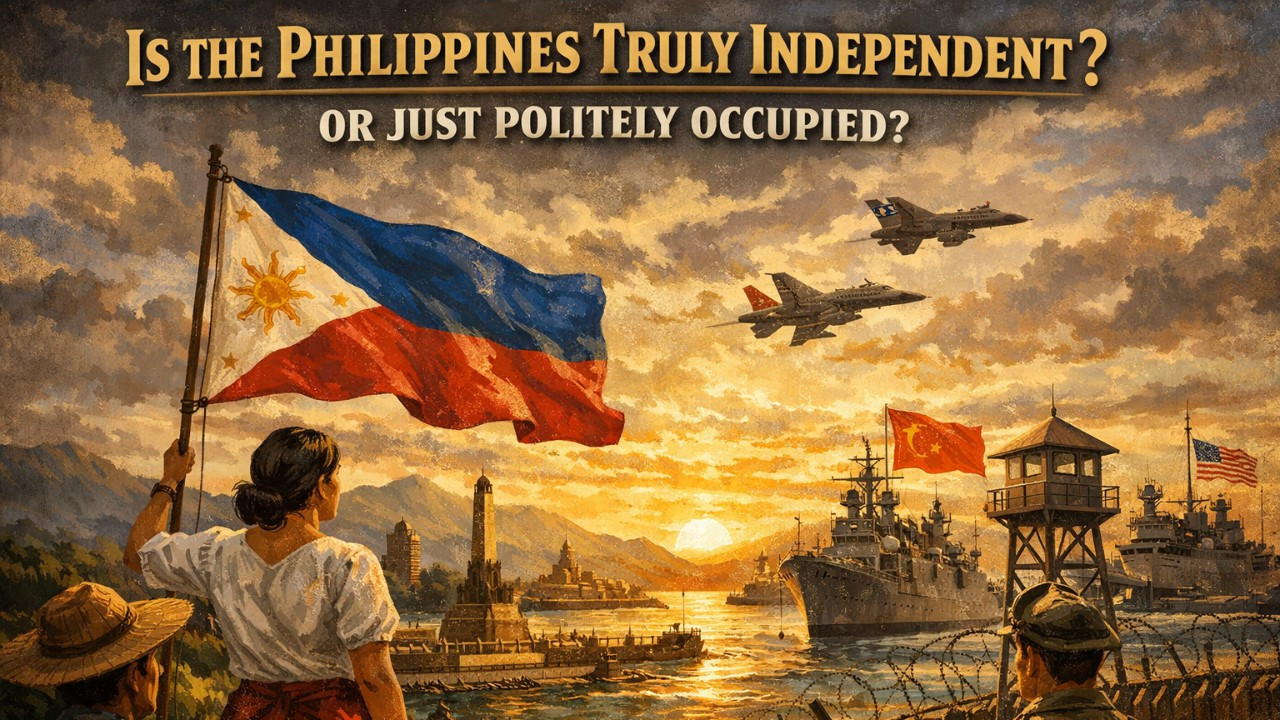
Is Philippines Truly Independent? Or Just Politely Occupied?
Filipinos like to say we are an independent nation. We wave our flag, celebrate our independence day, and claim sovereignty over our territory. Yet, when we look deeper, a different reality emerges. Are we truly independent, or are we merely politely occupied, controlled not by guns and soldiers, but by agreements, debts, and influence?
Military Presence Without a War
Officially, the Philippines is sovereign. Yet, the United States maintains a military presence under the Enhanced Defense Cooperation Agreement of 2014, which allows American troops access to our military bases, including Subic, Clark, and other strategic locations.
The agreement enables rotational forces, pre-positioning of equipment, and joint military exercises on Philippine soil.
We are told this is for our protection. But if a conflict arises in the South China Sea, the first country to experience consequences is the Philippines. Our territory becomes the frontline for foreign interests.
Debt as a Modern Chains
Economic dependence replaces guns. The Philippines national debt stands at sixteen trillion three hundred ten billion pesos.
Interest payments alone consume hundreds of billions of pesos annually, limiting how much the government can spend on health, education, and infrastructure. Loans from the World Bank, Asian Development Bank, and bilateral lenders often come with conditions influencing domestic policy.
No foreign flag waves in Manila, but these agreements shape our policy decisions, our budgets, and even our development priorities. Sovereignty is ceded not through force, but through economic necessity.
Foreign Influence on Policy and Politics
Independence is not just about territory. It is about the freedom to make decisions without external pressure.
Yet, the Philippines regularly aligns its policies with external powers. Military exercises like Balikatan are scheduled with U.S. strategic goals in mind. The Philippines foreign policy on the South China Sea is constrained by the need to maintain foreign aid, trade relationships, and defense agreements. Some argue that foreign corporations and banks, benefiting from tax incentives, special economic zones, and privatized public utilities, hold disproportionate influence over our economy.
Even elections and legislative decisions are subtly influenced by external funding, lobbying, and international observers. Independence becomes more perceived than actual.
Territorial Sovereignty Under Question
We are taught to celebrate the restoration of our territory after colonization, but sovereignty is fragile.
West Philippine Sea disputes show how territorial control does not equal freedom. Despite the 2016 Hague ruling against China’s nine-dash line, enforcement depends not on our own power but on international alliances and foreign naval presence. Philippine fishermen and coastal communities remain at the mercy of regional powers, unable to freely exploit resources in their own waters.
Cultural and Economic Soft Power
Occupation does not always require force. It thrives through soft power, culture, media, consumer habits, and economic dependence.
Our education system, media, and entertainment are heavily influenced by Western narratives. Filipino industries often rely on imported materials, foreign technology, and global supply chains, reducing the ability to act independently.
We are subtly trained to accept foreign leadership as normal, and to believe that dependence is modernization.
A Nation in Waiting
True independence means making military, economic, and political decisions without foreign approval, prioritizing Filipino interests above external pressures, and building industries and infrastructure that are self-sustaining and resilient.
Currently, the Philippines borrows, aligns, and coordinates to maintain favor with global powers, rather than acting freely in its own interest.
We are not colonized in the traditional sense. No soldiers march our streets. But polite occupation is just as real.
Our independence is conditional, mediated, and leased, not absolute.
The Choice Before Us
The question is urgent and unavoidable.
Will the Philippines rely on foreign powers for defense, development, and legitimacy? Or will we assert sovereignty, strengthen our economy, protect our territory, and educate citizens to think independently?
True independence is not a declaration. It is an action repeated every day, in policy, economy, and national consciousness.
Until then, we remain politely occupied, carrying the weight of freedom in name only, while our decisions are subtly guided by those who control our guns, wallets, and access to opportunity.