
Foreign Control and Modern Imperialism in the Philippines
Foreign Control and Modern Imperialism in the Philippines
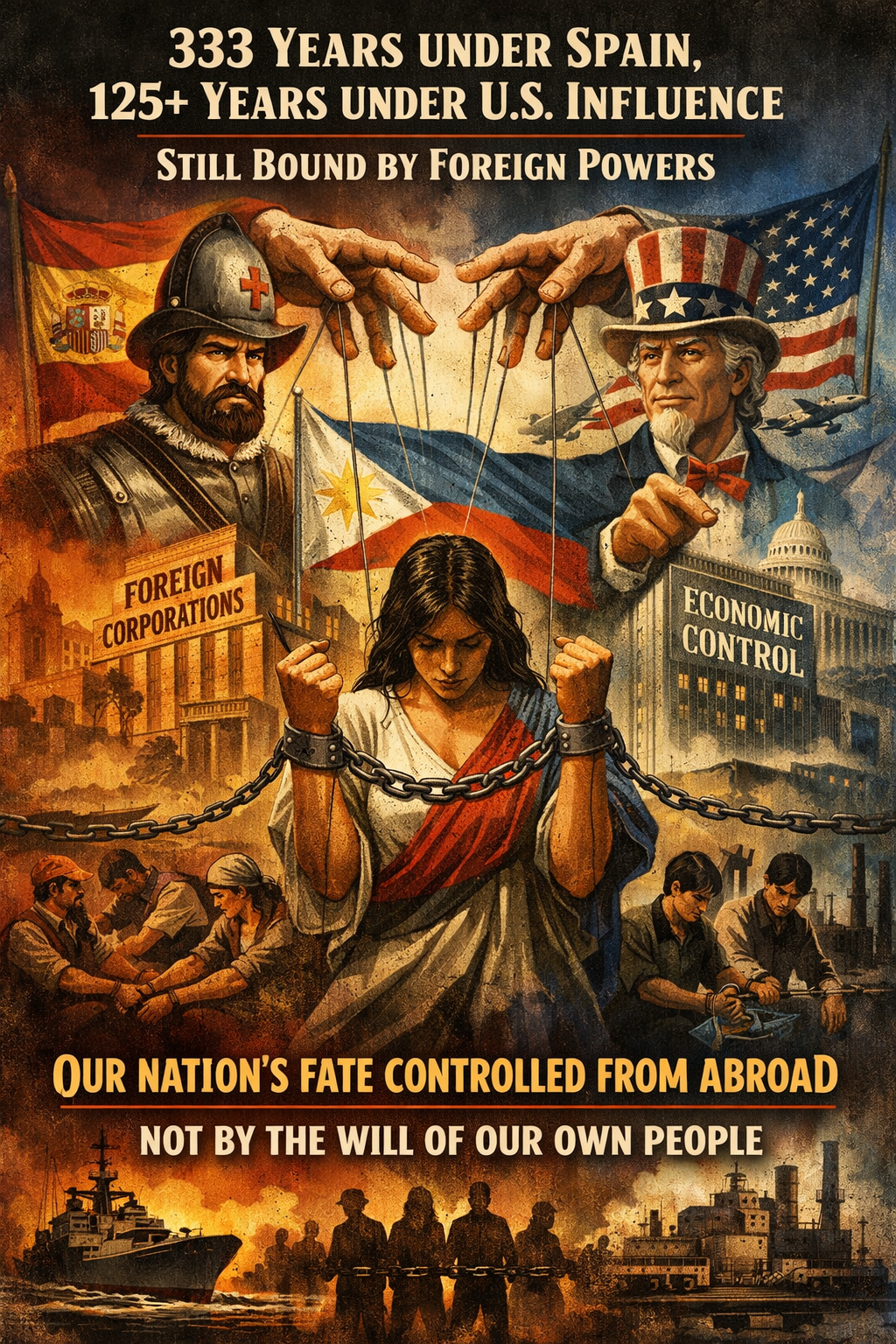
For centuries, the Philippines has lived under the shadow of foreign control. History books tell us that Spain ruled the islands for 333 years and that the United States followed for more than a century. These periods are often described as chapters that have already closed, relics of a distant past that ended with independence. But for many Filipinos, the reality feels very different. While foreign flags no longer fly over Malacañang, the systems of control remain deeply embedded in our economy, our policies, and even our way of thinking.
Imperialism did not disappear. It adapted.
From direct rule to indirect control
Spanish colonization reshaped Filipino society from the ground up. Land ownership was concentrated in the hands of a few. Local industries were suppressed. Filipinos were trained to serve, not to lead. When American rule replaced Spanish rule, it introduced a different structure but a similar outcome. Laws, education systems, and political institutions were redesigned to align with foreign interests. English became the language of power. American-style governance became the model.
When independence was declared, political authority was transferred, but economic and institutional dependency remained. The country inherited systems that were not designed for self sufficiency, but for integration into a global order where the Philippines occupied a subordinate role.
Economic imperialism in the modern era
Today, foreign control is rarely enforced through military occupation. Instead, it operates through economic structures that are harder to see and even harder to challenge.
Foreign corporations dominate key sectors of the Philippine economy. Mining operations extract minerals from Filipino soil, export them in raw form, and sell them back to the global market as finished products. Agriculture remains heavily export oriented, prioritizing cash crops for foreign buyers while local food prices continue to rise. Manufacturing is limited, keeping the country dependent on imports for higher value goods.
The Philippines participates in the global economy, but often at its lowest and least profitable levels. The value created by Filipino labor does not stay in the country. It flows outward, enriching foreign companies and investors while wages at home remain stagnant.
The export of labor as a national strategy
Perhaps the clearest symbol of modern imperialism is the export of Filipino labor. Millions of Overseas Filipino Workers keep foreign economies running as nurses, caregivers, construction workers, seafarers, and domestic helpers. Remittances are celebrated as a pillar of the national economy, but this reality comes at a profound cost.
Families are separated for years. Communities are hollowed out. The country becomes dependent on the income generated abroad rather than building sustainable industries at home. Instead of creating conditions where Filipinos can thrive locally, the system normalizes the idea that success requires leaving.
When a nation’s greatest export is its people, something is fundamentally wrong.
Control through policy and debt
Foreign influence also shapes national policy. Trade agreements are often negotiated in ways that favor larger and wealthier countries. Debt and development aid frequently come with conditions that dictate economic reforms, privatization, or spending priorities. These policies are framed as necessary for growth and stability, but they often limit the government’s ability to pursue independent development strategies.
Decision making becomes constrained. Choices are presented as technical necessities rather than political options. The result is a cycle where the country must continually adjust to external demands rather than setting its own direction.
In such an environment, sovereignty exists on paper, but autonomy is severely restricted.
Resource extraction and environmental sacrifice
The Philippines is rich in natural resources. Its seas are among the most biodiverse in the world. Its mountains contain valuable minerals. Its forests once covered vast areas of the archipelago. Yet these resources have rarely benefited ordinary Filipinos.
Foreign fishing fleets deplete local waters, leaving small scale fisherfolk struggling to survive. Mining operations displace indigenous communities and damage ecosystems that cannot be restored. Environmental destruction is treated as collateral damage in the pursuit of foreign investment.
The profits leave the country. The consequences stay behind.
This pattern reflects a colonial mindset that views the Philippines primarily as a source of raw materials rather than as a nation with the right to sustainable development.
Mental and cultural colonialism
Beyond economics and policy lies a quieter but equally powerful form of control: mental colonialism.
Generations of Filipinos have been conditioned to see foreign products, foreign systems, and foreign approval as superior. Local solutions are often dismissed as backward or impractical. Western models are copied without sufficient consideration of local context. Success is measured by alignment with global standards rather than by the well being of Filipino communities.
This mindset weakens resistance to exploitation. When dependency feels normal and inevitable, challenging it seems unrealistic or extreme. The most effective form of control is not force, but consent shaped by belief.
Independence without self determination
The core issue is not the presence of foreigners, but the absence of Filipino control. True independence requires the ability to decide how resources are used, how labor is valued, and how policies are shaped. Without this, independence becomes symbolic rather than substantive.
A nation cannot be considered free if its economy exists primarily to serve external interests. It cannot be sovereign if its development path is dictated by others. And it cannot be truly democratic if ordinary people have little say over decisions that affect their lives.
The role of centralization in exploitation
Centralized power makes a country vulnerable. When decisions are concentrated in a small group, they become easier to influence and capture. Foreign interests need only persuade or pressure a few institutions to shape outcomes for millions.
This concentration of power has deep roots in colonial governance. Central authorities were designed to extract resources efficiently, not to empower local communities. That structure remains largely intact today.
Decentralization as a path forward
Decentralization offers an alternative. By shifting power closer to communities, it becomes harder for external interests to dominate. Local people understand local needs. They are better positioned to protect their land, manage their resources, and hold leaders accountable.
When communities have real authority, wealth is more likely to circulate locally rather than flow outward. Transparency improves. Exploitation becomes visible and contestable. Development becomes rooted in lived reality rather than abstract economic targets.
Decentralization is not a cure all, but it directly challenges the conditions that allow modern imperialism to persist.
Reclaiming the future
Foreign control in the Philippines is not a conspiracy or an accident. It is the result of historical design, reinforced by economic structures and cultural conditioning. Understanding this reality is the first step toward changing it.
The question facing Filipinos today is not whether imperialism still exists, but whether we are willing to confront it. Real freedom requires more than independence ceremonies and national symbols. It requires control over our own destiny.
Until Filipinos reclaim authority over their land, labor, and laws, the promise of independence will remain unfulfilled. The struggle against imperialism did not end in the past. It continues in the present, and its outcome will shape the future of the nation.